
 中文简体
中文简体 English
 русский
Content
- 1 What Is a Swing Check Valve?
- 2 Swing Check Valve Diagram: Labeled Parts Explained
- 3 How a Swing Check Valve Works (Step by Step)
- 4 Horizontal vs Vertical Installation: Diagram Differences
- 5 T-Pattern vs Y-Pattern vs Wafer Swing Check Valves
- 6 Material Selection and Its Impact on Valve Design
- 7 Common Swing Check Valve Failures (with Diagram Reference)
- 8 Swing Check Valve Installation Best Practices
What Is a Swing Check Valve?
A swing check valve stops reverse flow with one moving part — a hinged disc. No external actuator, no handwheel, no signal. When fluid pushes forward, the disc swings open; when flow stops or tries to reverse, the disc slams shut against the seat. That simplicity makes it the most common non-return valve in water, wastewater, fire protection, and industrial cooling lines.
At its heart, every swing check valve relies on a disc that pivots on a hinge pin mounted above the flow path. The body is usually a straight-through (T-pattern) or angled (Y-pattern) casting, and the disc can be flat, curved, or fitted with a soft seal. The cutaway diagram of a typical valve shows exactly how these parts sit inside the pressure boundary — which is why engineers keep one on hand during installation and troubleshooting.
Unlike ball or lift check valves, swing check valves put the moving element entirely out of the flow stream when open. That gives them a distinct advantage in low-velocity services where pressure drop must stay low. But it also creates a unique set of hydraulic behaviors that the diagram can help you spot before the valve ever enters the pipeline.
Swing Check Valve Diagram: Labeled Parts Explained
A single cutaway drawing replaces a thousand words of valve specification. The diagram below identifies every component that matters for function, material choice, and failure analysis. Use it as a reference while reading the rest of this guide.

| Component | Typical Material | Function |
|---|---|---|
| Body | Ductile iron, cast steel, stainless steel | Pressure-retaining shell; forms the flow passage and houses all internals |
| Disc (Flap) | Ductile iron core with EPDM or NBR facing | The moving barrier that opens with forward flow and seals against reverse flow |
| Hinge Pin | Stainless steel (304 or 316) | Bearing shaft around which the disc swings; must resist corrosion and galling |
| Seat | Integral metal or resilient insert (EPDM, PTFE) | Sealing surface that the disc contacts; determines leak-tightness class |
| Cover (Bonnet) | Same as body, bolted with gasket | Top access for inspection; sealed with a gasket to prevent pressure loss |
| Flow Arrow | Cast into body exterior | Directional marking that the diagram must always match during installation |
The body’s internal contour molds the flow path. In a full-port design, the bore diameter stays constant from flange to flange, and the disc nestles into a recessed seat to keep the waterway wide open. The hinge pin sits near the top of the body, above the seat plane, so that the disc’s own weight helps it return to closed position when flow stops — a detail the diagram makes obvious the moment you look at the pin’s elevation relative to the seat centerline.
How a Swing Check Valve Works (Step by Step)
The mechanism hinges on three simple phases. Knowing them in order helps you predict how the valve will behave under partial flow, pulsating pressure, or sudden pump trip.
- Forward flow lifts the disc. Fluid pressure acting on the upstream face of the disc overcomes the disc’s own weight. The disc rotates around the hinge pin and swings up into the valve body until it reaches a nearly horizontal position, fully out of the flow stream. At this point, the valve presents minimum resistance — typically a Cv value that approaches that of a straight piece of pipe.
- Steady flow holds the disc open. As long as flow velocity stays above roughly 0.5 to 1 m/s (depending on disc mass), the dynamic pressure keeps the disc suspended. The exact cracking pressure needed to start opening the valve is a function of disc weight and hinge geometry — data that a good manufacturer’s diagram will annotate with the center of gravity distance.
- Reverse flow or zero flow slams the disc shut. When the pump stops or a downstream valve closes, the forward pressure collapses. Gravity pulls the disc downward, and any reverse flow pushes it even faster against the seat. The seat angle and disc mass determine the closure speed, which in turn dictates water-hammer risk — a critical factor you can evaluate only if the diagram shows the disc’s travel arc.
All three phases depend on one fact: the disc is always free to move. No spring, no actuator. The only forces are fluid momentum and gravity. That’s why vertical upflow installations demand careful engineering, a topic addressed next.
Horizontal vs Vertical Installation: Diagram Differences
Orientation rewrites the physics of disc closure. The same valve, bolted into a vertical pipe with upflow, behaves very differently than when mounted in a horizontal line. The difference appears clearly in two side-by-side diagrams.

| Parameter | Horizontal Installation | Vertical Installation (upflow) |
|---|---|---|
| Disc gravity assist | Full; disc weight directly aids closure | Minimal; disc weight acts sideways, not downward |
| Spring requirement | Usually none | Often mandatory; external spring or spring-loaded hinge |
| Minimum flow to open | Low; disc weight easily overcome | Slightly higher; less gravitational bias to overcome |
| Slamming risk | Moderate; gravity closes disc gradually | Higher; without spring, reverse flow can close disc abruptly |
| Disc position at rest | Hangs straight down against seat | Hangs at an angle; may not seal unless backpressure exists |
The diagram for a vertical installation always includes a dashed gravity vector pointing perpendicular to flow, showing that the disc’s own mass does very little to keep it sealed. To compensate, many manufacturers offer a spring-assisted model — the hinge pin includes a torsion spring that nudges the disc toward the seat. If you pull up the product diagram for a rubber disc swing check valve H44X-16Q, for instance, you’ll see the disc remains gravity-closed in horizontal orientation, but the optional spring kit is documented for vertical upflow use. Always check the installation diagram against the actual pipe orientation before ordering.
T-Pattern vs Y-Pattern vs Wafer Swing Check Valves
Three body styles dominate the market, and each one’s cross-sectional diagram tells a different story about flow efficiency and space claim.
| Feature | T-Pattern (Straight) | Y-Pattern (Angled) | Wafer (Compact) |
|---|---|---|---|
| Body shape | Straight-through, inline ports | Inlet and outlet at 45°–55° angle | Short face-to-face, sandwiches between flanges |
| Disc access | Top cover removal | Side or top cover, depending on angle | Usually non-serviceable; disc not removable without full disassembly |
| Cv (flow coefficient) | Highest; path nearly straight | Good; smoother than T for slurries | Lower; reduced bore possible |
| Face-to-face dimension | Long; per ASME B16.10 | Medium; shorter than T-pattern | Ultra-short; fits API 594 wafer pattern |
| Typical application | Water treatment, cooling towers | Boiler feedwater, steam condensate | Space-constrained piping, HVAC, fire protection |
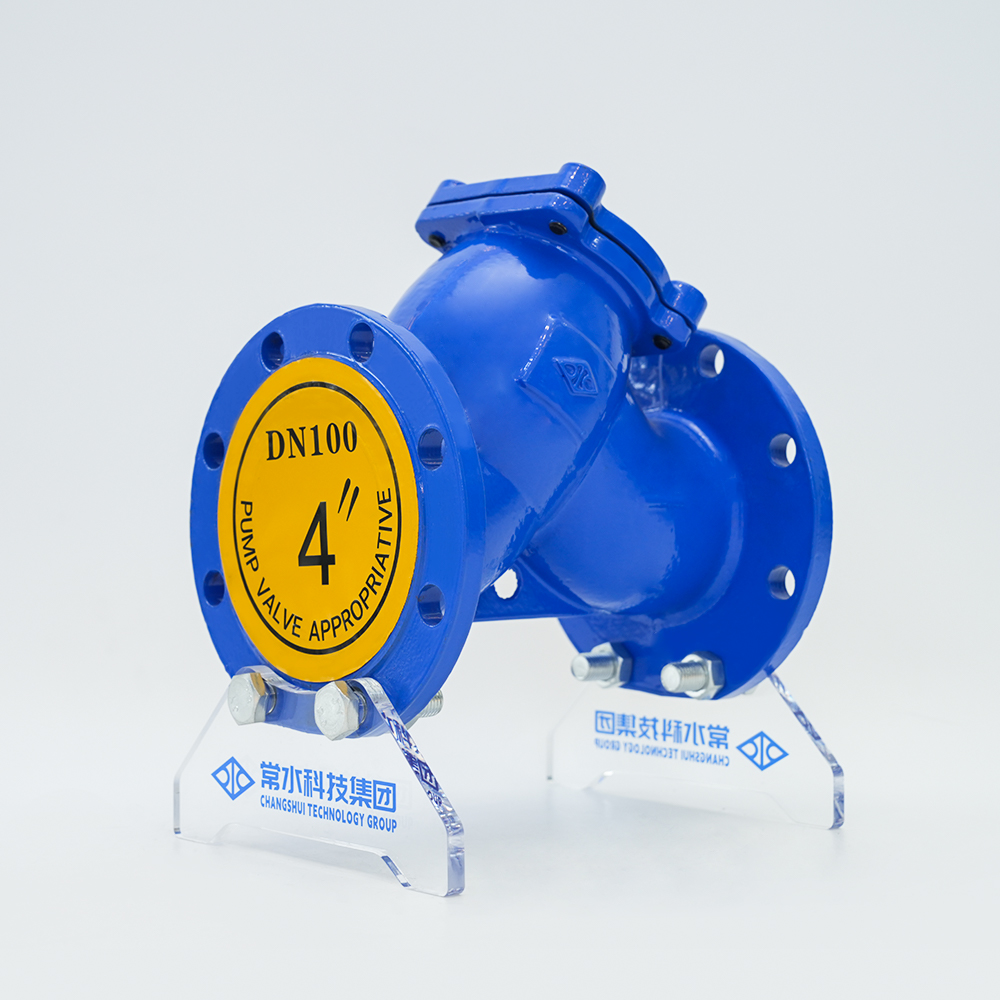
The T-pattern’s straight-through bore keeps the disc fully out of the flow, which is why the diagram shows a parallel flow arrow. The Y-pattern, however, angles the seat and disc, creating a more gradual turn that can reduce erosion in slurry services. Wafer designs force the disc to fit into a much shorter cavity; the resulting diagram often shows a reduced disc diameter and a body that requires precise alignment between flanges. For any of these, the diagram should mark the minimum clearance needed for hinge pin removal — a dimension frequently overlooked during piping layout. A grooved rubber disc check valve in the Y-pattern configuration, for example, will detail the exact pin extraction path on its approved drawing.
Material Selection and Its Impact on Valve Design
The metal you choose for the body doesn’t just change the nameplate — it changes the wall thickness, the seat design, and the internal contours visible in the diagram. Three common body materials illustrate the point.
| Material | Typical Wall Thickness | Seat Style | Best Media | Pressure Class (PN) |
|---|---|---|---|---|
| Ductile Iron (QT450-10) | 5–8 mm | Resilient (EPDM/NBR) insert | Clean water, sewage, oil-free air | 10, 16, 25 |
| Stainless Steel (304/316L) | 3–5 mm | Metal-to-metal or PTFE soft seat | Demineralized water, chemicals, food-grade | 10, 16 |
| Cast Steel (WCB) | 6–10 mm | Hardfaced metal (Stellite) or soft PTFE | High-temperature steam, thermal oil | 16, 25, 40 |
Thinner stainless steel bodies save weight but demand tighter casting tolerances, which the diagram shows as a narrower flange-to-seat clearance. Ductile iron valves, such as the rubber disc check valve H44X-16Q, trade that weight for a thicker, more vibration-resistant structure with an integral resilient seat that doubles as a gasket — the diagram captures this by displaying a dovetail groove machined directly into the body. Cast steel permits the highest pressures, but its thicker wall means a heavier disc, which in turn raises the cracking pressure; the diagram’s center-of-gravity annotation lets you calculate that directly.
Seal material is equally visible in the drawing. An EPDM-seated disc will show a pronounced rubber lip extruding beyond the metal lip; a PTFE seat appears as a thin white ring in the cutaway, and a hardfaced metal seat will show a defined weld overlay with a steeper contact angle. Always confirm that the diagram matches the intended service — ethylene propylene rubber swells in hydrocarbons, PTFE can deform under high cycles, and hard metal seats require lapped flatness for zero leakage.
Common Swing Check Valve Failures (with Diagram Reference)
When a swing check valve fails, the clue is almost always in the drawing. Mapping the symptom to the diagram’s parts speeds up root-cause analysis by days.
| Failure | Diagram Clue | Immediate Check | Fix |
|---|---|---|---|
| Disc seizure (won’t open or close fully) | Hinge pin area shows tight clearance or debris pocket | Inspect pin for corrosion, scale, or foreign objects | Replace pin with stainless steel; add filter upstream |
| Seat leakage (drips during closed position) | Seat lip appears eroded, indented, or cracked in cross-section | Check disc alignment; verify sealing face flatness | Replace resilient seat insert; regrind metal seats |
| Disc slam (water hammer on closure) | Arc of disc travel is long; no damping mechanism shown | Measure closure time from stop of flow; check missing spring | Install external dashpot; add spring assist |
| Flutter (rapid partial opening/closing) | Disc mass is low relative to flow velocity in diagram annotations | Calculate disc natural frequency; compare to flow pulsation | Switch to a heavier disc or use a guided check valve |
The disc seizure failure is the easiest to spot on a diagram. A poorly detailed drawing will omit the minimum clearance between the hinge pin and the body wall. If that gap fills with scale or a stray piece of gasket, the disc won’t move. In a properly dimensioned diagram, that clearance is called out as a critical installation note — typically “Min. 3 mm radial gap around hinge pin required.” Seat leakage, on the other hand, shows up as a mismatch between the disc’s sealing lip radius and the seat’s curvature. Even a 0.5 mm offset will produce a visible gap when the valve is viewed in the closed position cross-section.
Swing Check Valve Installation Best Practices
The right diagram won’t save a valve that’s bolted in backward or squeezed into a pipe without straight run. Follow these five checks, and always have the manufacturer’s installation drawing open at the jobsite.
- Flow arrow must match pipe direction. The cast arrow on the body is not decorative. If it points against flow, the disc will try to open in the wrong direction, jam, or hold open permanently.
- Provide 5x pipe diameter of straight pipe upstream. Turbulence from elbows or reducers can cause the disc to chatter. The diagram’s installation note will call out the recommended straight run — typically 5D on the inlet side.
- Leave space for hinge pin removal. Many technicians forget that the pin needs to slide out axially. The diagram will show the exact extraction zone, usually a clearance equal to the pin length plus 50 mm on one side.
- Tighten flange bolts in a star pattern to torque values in the manual. Uneven gasket compression distorts the seat ring, which the diagram’s exaggerated deformation analysis can illustrate. Target torque for ductile iron flanges is often 40–50 Nm for DN100.
- Test closure before system pressurization. With the line empty, push the disc closed by hand (through a small access port if available). It should seat firmly without binding. Any hesitation means the pin is dragging — a condition that a correct diagram will warn against with a note like “disc shall move freely without friction.”
If the valve will serve in vertical upflow, do not rely on gravity alone. The diagram for that installation must include a spring-loaded hinge detail. Otherwise, order a purpose-built vertical swing check valve — the standard model won’t seal when flow stops.