
 中文简体
 English
 русский

Content
- 1 What a Ball Valve Cutaway Actually Shows
- 2 Naming the Parts on a Ball Valve Cutaway Diagram
- 3 The Bore Tells You More Than the Body Size
- 4 Seats, Floating Balls and Other Details the Cutaway Reveals
- 5 Where a Cutaway Stops Being Useful
- 6 Using a Cutaway When You Select and Train
- 7 A Quick Checklist for Reading Any Cutaway
Somewhere between the handle and the pipe, a ball valve does its quiet work: a quarter turn, a bored sphere, and a pair of seats that decide whether the line stays tight for the next twenty years. None of it is visible from the outside. That is exactly why a ball valve cutaway earns its place in a catalogue, a submittal pack or a training slide — it turns a sealed lump of stainless steel or ductile iron into something you can explain to an apprentice, a buyer or a plant manager in a single glance.
What follows is how we read these drawings after years of machining bodies, lapping seats and answering questions from maintenance crews. We will go through what a cutaway really shows, how to name each part, and where the picture stops being enough.
What a Ball Valve Cutaway Actually Shows
A cutaway is a sectional drawing, not an artist's impression. A slice of the body wall is removed along a plane — usually a quarter or a half section through the centreline — so the internal chamber, the ball and the seat pockets are exposed. In properly prepared drawings, cut material is hatched: the diagonal lines tell you where solid metal was sliced away, while the bore is left clear so the flow path reads as an open tunnel from one end connection to the other.
Three details are worth spotting immediately. First, the bore through the ball should line up visually with the bore through the end connections; any mismatch tells you the valve is reduced port rather than full port. Second, the seats sit in pockets on both sides of the ball, and in a floating-ball design there is visible clearance behind them. Third, the stem passes through a packing chamber in the neck, and in a blowout-proof design the stem shoulder is wider than the passage it passes through — a small drawing detail with a large safety meaning.
Do not confuse a cutaway with an exploded view. An exploded view separates the parts to show assembly order; a cutaway keeps everything in working position so you can see how the parts sit against each other under pressure.
Naming the Parts on a Ball Valve Cutaway Diagram
Most cutaways, whatever the manufacturer, follow the same anatomy. If you can name these six items, you can read almost any of them.
| Part | What you see in the cutaway | Why it matters in service |
|---|---|---|
| Body | A hatched outer shell, often split into one, two or three pieces | Determines how the valve is serviced; multi-piece bodies allow seat replacement without cutting the pipe |
| Ball | A sphere with a cylindrical through-bore, usually shown polished | Controls flow on a 90-degree turn; surface finish and plating affect how long the seal lasts |
| Seats | Ring-shaped inserts seated against the ball on both sides | Provide the actual seal; material choice sets temperature and chemical limits |
| Stem and packing | A shaft through the neck, with packing rings and a gland | The most common leak path on any valve; blowout-proof stems prevent the shaft from ejecting |
| Bore | The clear tunnel through ball and body | Tells you whether the valve is full port or reduced port, and hints at pressure drop |
| End connections | Flanged faces, threads, socket ends or grooves | Must match the pipe standard on site, not just the valve size |
The Bore Tells You More Than the Body Size
Two valves stamped DN50 can behave quite differently. In a full-port valve the bore through the ball matches the internal diameter of the connecting pipe, so the cutaway reads as one continuous tunnel. In a reduced-port valve the bore is one or two nominal sizes smaller, and the drawing clearly shows the step down at each end of the ball.
That difference shows up in daily operation. Full port is the sensible choice where line cleaning pigs pass through, where the medium is viscous or contains solids, and where pressure drop matters on a long run. Reduced port costs less, needs less operating torque and takes up less space, which is why it dominates smaller domestic and utility lines. If a cutaway shows a noticeably narrow bore against a large flanged body, price and torque are probably the reason — and you should check the flow coefficient before you approve the submittal.
Seats, Floating Balls and Other Details the Cutaway Reveals
Floating versus trunnion-mounted
In a floating-ball valve, the sphere is held only by the two seats. Line pressure pushes the ball downstream into the seat, which is what creates the seal — and a cutaway shows that gap on the upstream side. In a trunnion-mounted valve you will see bearings or journals holding the ball top and bottom, so the ball rotates in place and the seats are pushed against it by springs or pressure. Trunnion designs appear as sizes and pressures climb, because operating torque stays manageable even when the seats are loaded hard.
Soft seats and metal seats
A soft-seated valve shows polymer seat rings, usually PTFE or a reinforced grade, sometimes with an elastomer energiser behind them. These give bubble-tight shutoff at moderate temperatures. Metal-seated versions show a harder ring, often with a secondary sealing arrangement, and are chosen for high temperature, abrasive slurries or where fire exposure is a design case.
Stem details
The neck area is where cutaways earn their keep. Look for a stem shoulder that cannot be blown out through the packing chamber, anti-static conduction between stem and body, and, in fire-safe designs, a secondary metal seat that takes over if the polymer burns away. None of this is visible on a photograph of a finished valve, which is why the cross-section is worth keeping in the maintenance file.
Where a Cutaway Stops Being Useful
A cross-section is a shape, not a specification. It will not tell you whether the body is CF8 or CF8M, which pressure class the wall thickness was calculated for, what the seat leakage rate is under API 598, or how much torque the stem will need after two years in hot water. Nor does it reveal casting soundness, machining tolerance or the test bench the valve will run on before dispatch.
Treat the drawing as the start of the conversation and the paperwork as the finish: material certificates, pressure-temperature ratings, test reports and dimensional drawings. If a supplier can show you a clean cutaway but not a certificate package, the picture has done more work than it should have.
Using a Cutaway When You Select and Train
In our own workshops, sectional drawings sit next to the assembly benches. New fitters learn where the seat sits before they touch a press, and sales engineers use the same drawing to explain why a three-piece body costs more but saves a shutdown later. For buyers, the cutaway is the fastest way to compare two quotations that look identical on paper: same size, same pressure rating, very different internals.
It also helps when comparing valve types. A ball valve holds a straight-through bore and seals on a quarter turn, while a butterfly valve uses a disc and a resilient liner in a much shorter face-to-face length — a trade-off we covered in this butterfly versus ball valve comparison.
The ball valves in our stainless steel range, such as the flanged Q41F-16P, follow the conventional two-piece pattern with a floating ball and PTFE seats, so the cutaway above will look familiar. If your line is water, heating or a mildly corrosive duty and the pipe is stainless, this is the model worth putting on the shortlist.
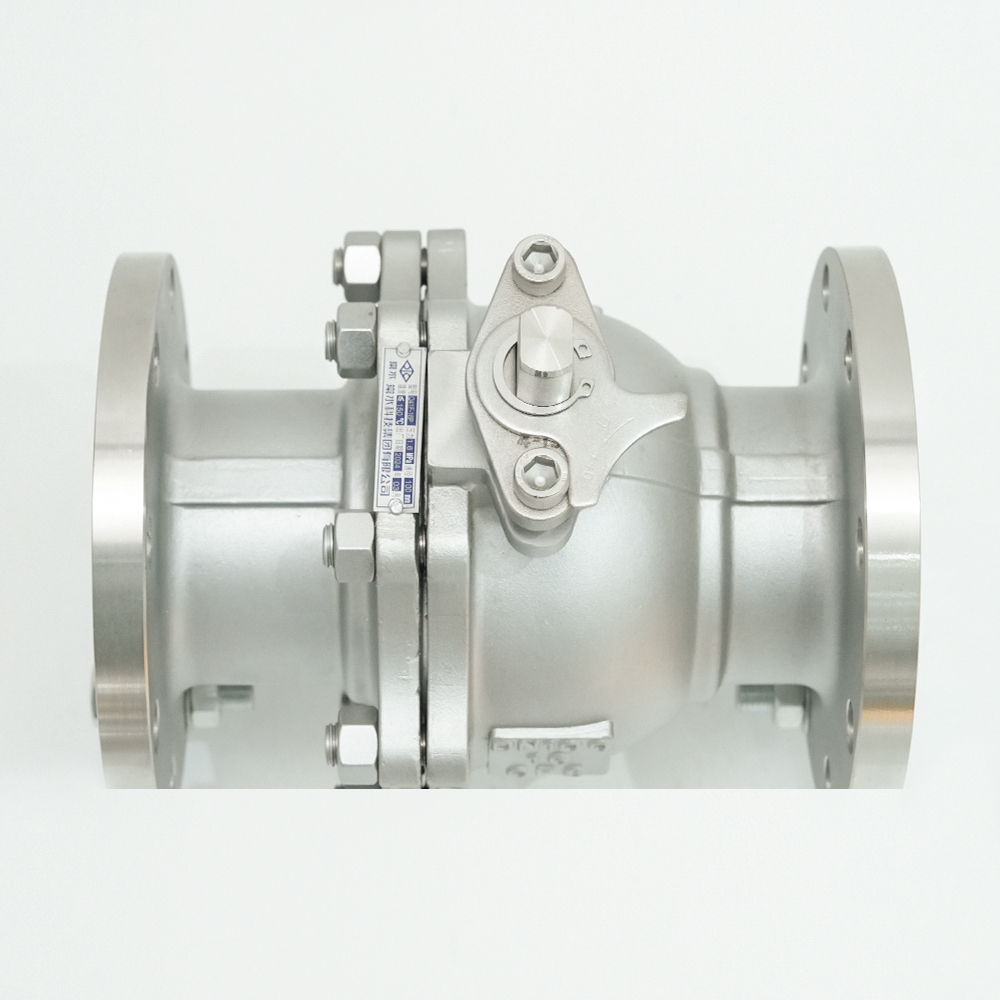 Stainless Steel Flanged Ball Valve Q41F-16PA flanged stainless steel ball valve for isolating or connecting lines; consider it for stainless pipework in water, heating or mildly corrosive service.View Product →
For ductile iron pipework we generally steer customers toward gate, butterfly and check valves, since that is where that material family is strongest — but the reading method stays the same. Whatever the model, ask for the section, then ask what the section does not show.
A Quick Checklist for Reading Any Cutaway
- Confirm the section plane: is the drawing cutting through the bore centreline, or offset?
- Check bore continuity to judge full port against reduced port.
- Look behind the seats to identify floating or trunnion-mounted construction.
- Find the stem shoulder and packing set; verify blowout-proof geometry.
- Note how many body joints exist, because that sets the service method.
- Match end connections and face-to-face dimensions against the pipe standard in use.
A good ball valve cutaway does one job well: it shows you how the seal is made and where it can fail. Everything else — grade, rating, testing, torque — comes from the documents that travel with the valve. If you are weighing up options for a particular line and want to talk through the internals rather than just the price, our team is always happy to open the drawing with you.